The Bitter Orange Tree
August 2026
A complete guide to Neroli, Petitgrain & Bitter Orange
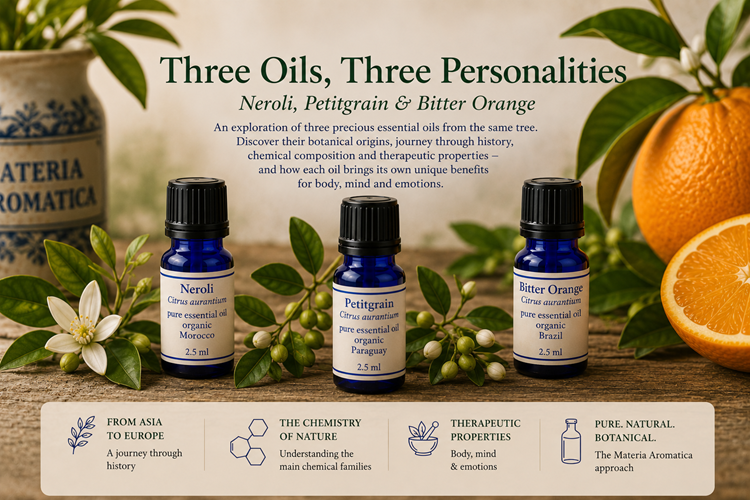
The bitter orange tree (Citrus aurantium var. amara) is one of nature's greatest aromatic masterpieces. Unlike almost every other medicinal plant, it offers not one but three distinct essential oils, each produced from a different part of the tree.
From its delicate blossoms comes the precious fragrance of Neroli. From its leaves and young twigs, the fresh green essence of Petitgrain. From the peel of its fruit, the bright vitality of Bitter Orange.
Although they share the same botanical origin, these oils possess remarkably different chemical compositions, aromas and therapeutic properties. Nature has carefully distributed different groups of aromatic molecules throughout the tree, giving each part its own purpose and its own unique personality.
This remarkable diversity explains why one tree can comfort a grieving heart, calm an anxious mind, or restore energy and optimism—simply by expressing different parts of itself.
1. A Short Journey through History
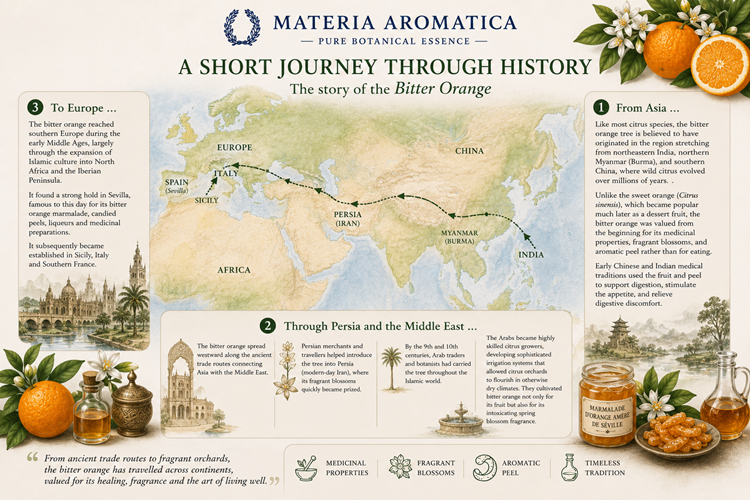
From Asia …
Like most citrus species, the bitter orange tree is believed to have originated in the region stretching from northeastern India, northern Myanmar (Burma), and southern China, where wild citrus evolved over millions of years.
Unlike the sweet orange (Citrus sinensis), which became popular much later as a dessert fruit, the bitter orange was valued from the beginning for its medicinal properties, fragrant blossoms, and aromatic peel rather than for eating.
Early Chinese and Indian medical traditions used the fruit and peel to support digestion, stimulate the appetite, and relieve digestive discomfort.
Through Persia and the Middle East …
The bitter orange spread westward along the ancient trade routes connecting Asia with the Middle East. Persian merchants and travellers helped introduce the tree into Persia (modern-day Iran), where its fragrant blossoms quickly became prized.
By the 9th and 10th centuries, Arab traders and botanists had carried the tree throughout the Islamic world.
The Arabs became highly skilled citrus growers, developing sophisticated irrigation systems that allowed citrus orchards to flourish in otherwise dry climates. They cultivated bitter orange not only for its fruit but also for its intoxicating spring blossom fragrance.
To Europe …
The bitter orange reached southern Europe during the early Middle Ages, largely through the expansion of Islamic culture into North Africa and the Iberian Peninsula with a strong hold in Seville, famous to this day for its bitter orange marmalade, candied peels, liqueurs and medicinal preparations. It subsequently became established in Sicily, Italy and Southern France.
2. Three Gifts from One Tree
3 different essential oils, each with its unique personality, are extracted from the tree.
Neroli …
Is steam-distilled from the white flowers that have been prized for their velvety, soft and floral tones for centuries. The name of ‘Neroli’ is believed to be a more recent chapter in the tree’s history and began during the 17th century. According to tradition (perhaps more a mix of documented and legendary counts), an Italian noblewoman, Anne Marie Orsini, Princess of Nerola near Rome, became captivated by the fragrance of distilled orange blossoms. She perfumed her gloves, bathwater, clothing, and even her palace with the precious oil. The fragrance became so fashionable that the blossom oil soon became known simply as Neroli, a name it retains today.
Neroli is one of the most expensive essential oils. The yield varies between 0.08 to 0.15%. Around 800 to 1,000 kg of blossoms, potentially more, are needed to produce 1 kg of essential oil. The delicate nature of the flowers, the shortness of the season and the sheer number needed to produce a small amount of oil make it a labour intensive process which is reflected in its high price.
Petitgrain …
While the blossoms were reserved for producing the precious neroli oil, growers discovered that the leaves and young twigs also yielded an aromatic essential oil.Originally, the oil was distilled from the small immature green fruits, known in French as petits grains (“little grains”), which gave the oil its name.As production evolved, distillers found that the leaves and tender twigs produced a higher yield and comparable aroma without compromising either flowers or fruit. Modern petitgrain essential oil is therefore almost always distilled from leaves and young branches, although the historical name remains.
Leaves and twigs are much easier to harvest on a regular basis and are available on a much larger scale. The yield is typically between 0.2 to 0.8% or 125 to 500 kg of material to produce 1 kg of essential oil This brings the cost of production drastically down, makes the oil of petitgrain a lot cheaper than Neroli and therefore more affordable.
Bitter Orange Peel ..
The essential oil is held in secretory cells hidden in the peel. The oil is commonly extracted through cold expression and is often a by-product of the food and juice industries. The peel yields between 0.5 to 2% which translates into 50 to 200 kg of peels needed to produce 1 kg of essential oil.
3. One Tree, Three Different Chemistries
Before exploring the therapeutic properties of these remarkable oils, let's take a brief journey into their chemistry. It will only be a short and simple easy-to-follow overview of the main chemical families found in Neroli, Petitgrain and Bitter Orange and will help to explain why three essential oils from the same tree possess such different aromas, personalities and healing attributes. Once one understands the chemistry, everything else begins to make perfect sense.
The chemistry of an essential oil forms the foundation of its therapeutic properties. Each oil is composed of hundreds of naturally occurring molecules that define the exact character and personality of an essential oil, from its aroma to its specific actions on the body and mind. These molecules, with similar profile and therapeutic actions are grouped into distinct chemical families. Understanding these chemical families allows us to look beyond the aroma and appreciate the fascinating science that gives every essential oil its unique personality.
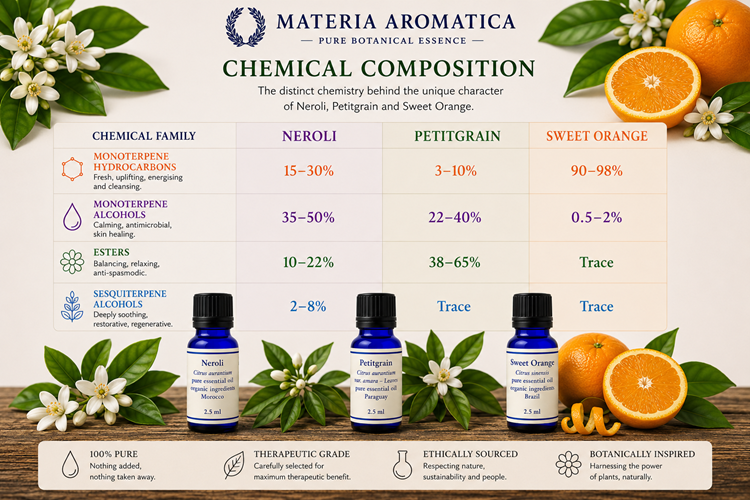
4 chemical families play a significant role in the essential oils of our story. These are Monoterpenes Hydrocarbons, Monoterpenes Alcohols, Esters and Sesquiterpene Alcohols. What becomes interesting is that both Neroli and Petitgrain are largely made up of compounds found in 3 of these families, but in proportions that are vastly different, thus producing 2 oils with many common elements but with their unique aromas and therapeutic properties.
Let’s take a look…
| **Chemical Family |
Nerili |
Petitgrain |
Bitter Orange** |
| Monoterpene Hydrocarbons |
5-30% |
3-10% |
98-98% |
| Monoterpene Alcohols |
35-50% |
22-40% |
0.2-20% |
| Esters |
10.22% |
38-65% |
Traces |
| Sesquiterpenes Alcohols |
2-8% |
Traces |
Traces |
In Simple Terms ….
Neroli is an oil dominated by monoterpene alcohols, especially linalol, enriched with esters and precious sesquiterpene alcohols that lend depth and restorative qualities.
Petitgrain is built around esters, particularly linalyl acetate, with some monoterpene alcohols, making it one of the finest balancing oils in aromatherapy.
Bitter Orange is overwhelmingly composed of monoterpene hydrocarbons, primarily limonene, giving it its sparkling freshness and invigorating nature.
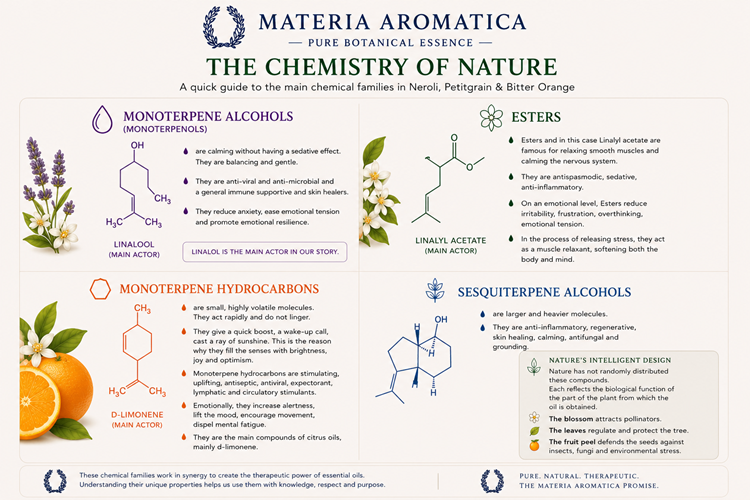
For a quick sum up of each group
Monoterpene alcohols (Monoterpenols) …
are calming without having a sedative effect. They are balancing and gentle. They are anti-viral and anti-microbial and a general immune supportive and skin healers. They reduce anxiety, ease emotional tension and promote emotional resilience. Linalol is the main actor in our story.
**Esters …**n
Esters and in this case Linalyl acetate are famous for relaxing smooth muscles and calming the nervous system. They are antispasmodic, sedative, anti-inflammatory. On an emotional level, Esters reduce irritability, frustration, overthinking, emotional tension. In the process of releasing stress, they act as a muscle relaxant, softening both the body and mind.
Monoterpene hydrocarbons…
are small, highly volatile molecules. They act rapidly and do not linger. They give a quick boost, a wake-up call, cast a ray of sunshine. This is the reason why they fill the senses with brightness, joy and optimism.
Monoterpene hydrocarbons are stimulating, uplifting, antiseptic, antiviral, expectorant, lymphatic and circulatory stimulants. Emotionally, they increase alertness, lift the mood, encourage movement, dispel mental fatigue.
They - mainly d-limonene - are the main compounds of citrus oils.
**Sesquiterpenes alcohols… **
are larger and heavier molecules. They are anti-inflammatory, regenerative, skin healing, calming, antifungal and grounding.
Nature has not randomly distributed these compounds. Each reflects the biological function of the part of the plant from which the oil is obtained. The blossom attracts pollinators, the leaves regulate and protect the tree, and the fruit peel defends the seeds against insects, fungi and environmental stress.