Lime
Brightness in Every Drop!
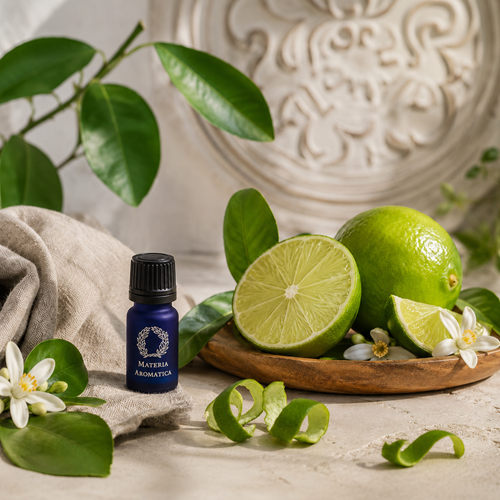
Lime essential oil is obtained from the fruit of Citrus aurantiifolia, a small evergreen tree belonging to the Rutaceae family. Native to Southeast Asia and now cultivated throughout tropical and subtropical regions, the tree typically reaches 3–5 metres in height and has a dense, rounded canopy of glossy green leaves. Its slender branches are often armed with short thorns, while its fragrant white flowers, tinged with purple on the outside, bloom throughout much of the year in warm climates.
The tree produces small, round to oval fruits with thin green skins and a juicy, highly acidic pulp. Harvested before they fully ripen, these vibrant green fruits are prized not only for their culinary uses but also for the aromatic oil contained within their peels. Thriving in sunny, frost-free environments, Citrus aurantiifolia is valued for its abundant fruit production and its intensely fresh, characteristic citrus fragrance.
Like with all citrus trees, three different essential oils are produced from the aerial parts of the lime tree. The steam distillation of the leaves and twigs produces an oil referred to as Lime Petitgrain to differentiate it from Petitgrain or Petitgrain Bigarade which is the result of the distillation of the leaves and twigs of the bitter orange tree citrus x aurantium. Similarly, the flowers are sometimes distilled to produce a neroli-like oil. This is not to be confused with Neroli which typically is the steam-distillation of the flowers of the bitter orange tree. Although these 2 oils can be found on the market, they are rarely used in Aromatherapy which favours the True Petitgrain and Neroli.
The success of the lime trees is undeniably its fruits that are a favourite of the food and fragrance industries. Nothing goes to waste and flesh, seeds and rind are all put to good use to produce extracts of various natures.
The essential oil is concentrated in specialized oil glands located throughout the rind. These aromatic compounds act as a natural chemical defence, helping to shield the developing seeds from external pathogens, predators and other environmental threats until they fully mature.
Essential Oil Extraction
Expression or Steam Distillation
Like all citrus fruits, lime essential oil is commonly produced by cold expression (also known as cold pressing) of the fruit peel. In this process, the outer rind is mechanically pressed to release the aromatic compounds held in the oil glands, capturing the fresh, vibrant scent that is characteristic of the fruit.
Lime essential oil can also be obtained through steam distillation which produces an oil with a slightly softer, less sharp citrus aroma and removes the naturally occurring compounds responsible for phototoxicity. For this reason, distilled Lime oil is often preferred in skincare applications where sun exposure may be a concern.
The method of extraction significantly influences the oil's aroma and properties. Expressed Lime oil retains the bright, juicy character of freshly peeled fruit, while distilled Lime oil tends to be drier, lighter, and more subtle in fragrance.
This profile concentrates on the essential oil that is extracted through cold-expression as it is the oil that Materia Aromatica offers in its range and compares more accurately with other citrus oils that are also obtained through cold expression.
Chemical Profile
&
What Makes Lime Different to the Other Citrus OIls
CHEMICAL PROFILE
Going through a chemical analysis may sound dry and overwhelming for most of us who don't have the slightest interest in chemistry let alone any knowledge, but it does help understand the personality and character of an essential oil. So, let's take a look!
Lime is green, sparkling and fresh and owes it to the high proportion of monoterpenes hydrocarbons (75 to 90%), particularly d-limonene, β-pinene and γ-terpinene.
Smaller amounts of oxygenated monoterpenes (2 to 8%) citral (neral and geranial), linalool and terpienol-4-ol give the oil its distinguished crisp, bouncy, bright personality despite the very small amount it holds.
Although it represents only a very small proportion of lime's chemical make-up, less than 3 %, the third significant group of compounds is made up of sesquiterpenes. Those have a higher molecular weight, less volatility and therefore a longer persistence. Despite their minute contribution, they give the essential oil Its distinctive complexity and depth of aroma allowing it to linger longer than its citrus counterparts. These are typically β-Caryophyllene, α-Bergamotene, β-Bisabolene, Germacrene D and α-Humulene.
Finally the oil also contains naturally occurring furanocoumarins derived from the peel, a characteristic feature of cold-expressed citrus oils.
WHAT MAKES LIME DIFFERENT TO THE OTHER CITRUS FRUiTS
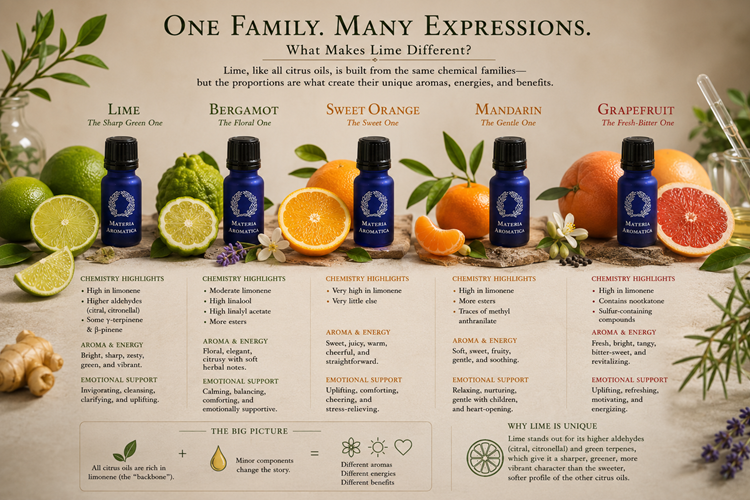
Expressed lime, sweet orange, mandarin, grapefruit, and bergamot oils are built from the same major chemical families - monoterpene, oxygenated monoterpenes, sesquiterpenes, and, in some cases, furanocoumarins — but in markedly different proportions. The relative proportions of those families create their very distinctive aromas and therapeutic profiles.
** Lime vs Orange**
Sweet Orange is essentially a limonene-rich oil, with limonene often exceeding 90%. This gives it a sweet, juicy, rounded character.
Lime contains far less limonene but significantly more β-pinene and γ-terpinene, creating a greener, sharper and more complex profile.
Orange: sweet, soft, fruity.
Lime: crisp, tangy, green, vibrant
** Lime vs Mandarin**
Mandarin also contains abundant limonene, but its distinctive character comes from higher γ-terpinene, which contributes sweetness and softness.
Compared with Mandarin, Lime contains more pinenes and citral, giving it greater freshness and less sweetness.
Mandarin: sweet, mellow, deeper than orange but almost candy-like.
Lime: drier, brighter, more incisive.
** Lime vs Grapefruit**
Grapefruit is one of the most limonene-dominant citrus oils. Its characteristic bitterness comes not from large chemical differences but from subtle trace constituents.
Lime contains much higher levels of β-pinene and γ-terpinene, making it noticeably greener and more aromatic.
Grapefruit: fresh, airy, bitter-citrus.
Lime: sharper, greener, more concentrated.
** Lime vs Bergamot**
Bergamot is chemically the most distinct of these oils.
While lime is dominated by hydrocarbon monoterpenes, bergamot contains substantial quantities of linalool and linalyl acetate, giving it a uniquely floral and elegant character.
Bergamot: floral, refined, rounded, tea-like.
Lime: crisp, zesty, green, sparkling.
Finally leaving the chemistry behind and for a short summary
and ease of Understanding
From the sweetest and rounded to the most green and incisive:
Sweet Orange → Mandarin → Grapefruit → Bergamot → Lime
From the highest limonene content to the lowest:
Sweet Orange ≈ Grapefruit > Mandarin > Lime > Bergamot
From the most floral to the most bitter
Sweet Orange → Mandarin → Bergamot → Lime → Grapefruit
This comparison based on the chemical analysis of each citrus oil points out why lime often feels more energetic and penetrating than its friends. Its unusually high levels of β-pinene, γ-terpinene, and citral, combined with a lower proportion of limonene, give it a distinctive fresh, tangy, and slightly bitter character with greater depth than lemon and less sweetness than orange or mandarin.
THERAPEUTICALLY
The fresh, invigorating and joyful aroma of lime is re-known for its ability to calm the mind, to uplift and instil joy. In the inevitable ups and downs of life, in those moments when one needs to take a rest, to recharge and find renewed level-headedness, lime brings comfort, inspiration, strength and mental clarity.
Lime is an immune-booster and supports respiratory functions during flu or colds. It will help decongest and clear excess mucous in the sinuses and lungs. Use with Eucalyptus’, Ravintsara, thyme linalool, Pine, Frankincense.
Lime has carminative properties, soothes and support the digestive tract by helping to relieve bloating, indigestion and nausea
Lime is anti-septic and anti-microbial. It is commonly used in skin care formulations targeting outbursts of acne. If used in this instance, it is important to use the oil distilled via steam-distillation as the process will remove the phyto-toxic compounds of the oil that are still present in the oil extracted through cold expression. It is highly recommended to avoid using expressed lime oil directly on parts of the skin that will be exposed to sunlight.
BLENDING WITH LIME
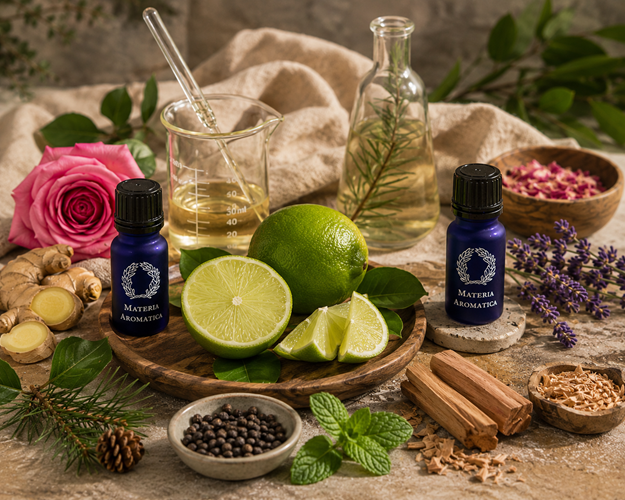
Lime is very easy going and will blend happily with most essential oils if not all, the members of its own family of course, the flowers, woods, spices even the pungent groups of the eucalypti and rosemary’s softening their explosive nature.
Lime is high in D-limonene which is highly volatile. As it has more depth than orange and lemon, lime will tend to keep fresh for a little longer. However, lime is a top note and will be the first to leave the party. It will therefore need companions to convince it to stay a little longer.
A few ideas to inspire our readers to use lime either in their practice or as part of their daily life.
The following blends can be used in a burner as an air freshener, to prepare a work place before the arrival of a client, to cleanse and renew the air in an office or home either in the morning or after a long day, to inspire the body to relax and prepare it for a meditative state or to simply sit down and enjoy a moment of peace in a comfortable armchair with a cup of tea at hand… The ideas are endless and these are only a few to engage the creative spirit of our readers.
CLARITY & PEACE
Based on 10 drops of essential oils or 1/3 ml.
Quiet Mind
A blend for calming mental chatter while maintaining alertness.
Fresh, spacious, and meditative.
Ideal for meditation, yoga, or moments of reflection.
2 drop Lime
4 drops Frankincense
1 drops Lavender
Inner Balance
A blend that encourages emotional equilibrium and gentle focus.
The citrus notes create brightness while Petitgrain adds a grounding, leafy calm.
4 drops Lime
4 drops Petitgrain
2 drops Bergamot
Still Waters
For slowing a busy mind at the end of the day.
The earthy base notes provide stability and grounding, while Lime keeps the blend from feeling too heavy.
3 drops Lime
4 drops Cedarwood Atlas
2 drops Lavender
1 drop Vetiver
Clear Presence
A blend designed for mindfulness practices and focused work.
Quieting, centring, and contemplative with a subtle citrus lift.
4 drops Lime
3 drops Frankincense
3 drops Sandalwood
Forest Walk & Christmas Spirit
A refreshing yet grounding blend.
Evokes a walk through a sunlit forest and promotes calm concentration.
4 drops Lime
2 Eucalyptus radiata
2 drops Black Spruce
2 drops Cypress
Citrus indulgence
A sophisticated aromatic blend.
Balancing, serene, and emotionally supportive with a beautiful depth.
3 drops Lime
3 drops Neroli
3 drops Frankincense
1 drop Vetiver
RESPIRATORY & LUNG COMPLAINTS
While Eucalyptus, Ravintsara, Pine, Tea Tree, and Rosemary typically provide the primary respiratory support, Lime brings brightness and vitality, helping to counter the lethargy that often accompanies seasonal respiratory discomfort.
Clear Breathing
Fresh, cleansing, and calming. Eucalyptus radiata, frankincense, ravintsara and black spruce not only offer a decongesting action but have also the ability to bring calm and relaxation to induce a repairing sleep whilst lime adds freshness and a soothing note.
10 drops on a tissue by the bed at night or for creating a refreshing atmosphere during the winter months.
2 drops Lime
2 drops Frankincense
2 drops Ravintsara
2 drops eucalyptus radiata
2 drops black spruce
For persistent cough
For topical use
To 10 mL of carrier oil add at a 2% dilution
apply to the chest and upper back once or twice a day
1 drop Lime
2 drop Ravintsara
2 drops Thyme linalol
1 drop Pine
1 drop Lavender
CARMINATIVE BLEND
Digestive Ease
Br Bright and warming, this blend combines the carminative properties traditionally associated with citrus and spice oils. The sparkling freshness and sweetness of Orange and Lime complement the comforting warmth of Cardamom and Ginger, creating a balanced aroma that supports digestive wellbeing and post-meal comfort.
Use in a diffuser or in 2% dilution in a carrier oil which is about 6 drops in 10ml of jojoba or sunflower oil. Massage the abdomen gently in a clockwise direction.
2 drops lime
2 drops Orange
3 drops Cardamon
3 drops Ginger
CAUTION
**Expressed lime essential oil is phototoxic. Do not use in formulations that are aimed to be used on parts of the body that will likely receive sun exposure. **